
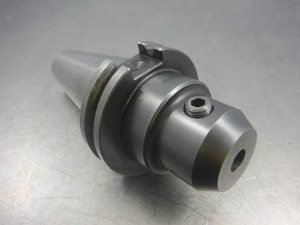
CAT tool holders are the V-flange tooling that connects a cutting tool to the spindle of a CNC machining center. If you run vertical or horizontal mills with a North American taper, CAT 40 tool holders and CAT 50 tool holders — usually written CAT40 and CAT50 — are almost certainly what fill your tool carousel. The cutting tool seats in the holder, the holder seats in the spindle on a steep 7:24 taper, and a retention knob pulls it tight so nothing moves under load. This page covers what CAT means, the taper geometry behind it, how CAT40, CAT50, and CAT60 compare, and the verified dimensions for each size.
We also buy used and surplus CAT tool holders. If you are clearing a tool crib or switching machines, you can sell your used tool holders to us by the lot rather than one at a time. More on that below.
Sell your used CAT40 and CAT50 tool holders
Retiring a machine or clearing the crib? We buy CAT40 and CAT50 holders by the lot, mixed brands and any condition. Send a few photos and a rough count for a fast quote.
Call 517-514-5196 or fill out the quote form below.
What CAT Tool Holders Are and How They Work
A tool holder is the device that grips a cutting tool and locates it precisely in the spindle of the machine. The cutting tool is mounted into the holder and tightened so it does not move during machining. CAT, short for the Caterpillar V-flange interface, is one of the most common tool holder standards in North American shops and is used throughout CNC milling.
The V-flange (CV) taper interface is commonly associated with a design from Caterpillar and was standardized in North America under ASME B5.50 (formerly ANSI B5.50). That standard, not a trade association, is what defines the taper, the flange, and the retention knob threads you see in the dimension grids further down this page. CAT holders are sometimes called Caterpillar “V-flange” holders for exactly this reason.
The defining feature of a CAT holder is its taper. CAT uses a 7:24 steep, self-releasing machine taper, which works out to 3.5 inches of taper per foot, or an included angle of roughly 16.6 degrees. This is not a Morse taper. A Morse taper is a shallow, self-holding taper that grips by friction and stays put on its own. The CAT 7:24 taper is deliberately steep so it will release cleanly for automatic tool changes, which means it does not hold itself in. Instead, a retention knob (also called a pull stud) threaded into the back of the holder is gripped by the drawbar inside the spindle, and that drawbar force pulls the taper tight against the spindle bore. Release the drawbar and the holder pops free for the next tool.
A CAT holder has two main parts: the taper (shank) that seats in the spindle, and the flange and holding head at the front that grip the cutting tool. CAT tooling accepts both Imperial and Metric tools depending on the holding head, and it uses Imperial thread retention knobs. Because the taper releases cleanly, CAT holders work well with ATC (Automatic Tool Change) when the machine supports it.
CAT Sizes: CAT30, CAT40, CAT50, CAT60
CAT tooling is widely used and easy to acquire. The standard sizes are CAT30, CAT40, CAT50, and CAT60. The number refers to the size of the taper: the higher the number, the larger the taper and the more rigid and capable the holder. CAT40 and CAT50 cover the vast majority of working shops, CAT30 shows up on lighter and high-speed machines, and CAT60 lives on large, heavy mills.
The table below summarizes how the common sizes line up. The gauge diameters and retention knob threads match the verified dimension grids further down the page.
| Size | Gauge (taper big-end) diameter | Retention knob thread | Typical use |
|---|---|---|---|
| CAT30 | 1.250 in (31.75 mm) | 1/2-13 | Lighter-duty and high-speed machining centers where mass and changeover speed matter. |
| CAT40 | 1.750 in (44.45 mm) | 5/8-11 | The workhorse size for general-purpose vertical machining centers. |
| CAT50 | 2.750 in (69.85 mm) | 1-8 | Heavier cuts, larger machines, and demanding production where rigidity matters. |
| CAT60 | 4.250 in (107.95 mm) | 1 1/4-7 | Large, heavy mills and boring mills running big tooling. |
CAT vs BT Tool Holders
CAT and BT holders look similar and share the same 7:24 steep taper, so the shank that seats in the spindle is geometrically the same angle. They are not interchangeable, though, and the differences are in the parts around the taper. CAT holders use a thicker flange and an Imperial thread retention knob, while BT holders (a Japanese JIS standard, BT for the older MAS 403 / “BT” designation) use a symmetric flange and a metric retention knob. The drive-key slots and gauge-line geometry also differ. In short, the taper matches but the flange thickness, retention knob thread, and drive-key spacing do not, so a CAT holder will not run correctly in a BT spindle and vice versa. If you are weighing tapers across your shop, our overview of the difference between BT and HSK tool holders covers the rest of the common interfaces.
Cat50, Cat40, Cat30 ER Collet Chucks
-
- Cat 30 Tool Holder
-
- Cat 40 Floating TAP Tool Holder Tier 16
ER collet chucks handle a wide range of machining jobs without having to buy new tool holders. Simply choose the right size collet for the job, set the tool depth, tighten the collet nut, and pull the stud to the proper torque using a torque wrench and tightening fixture.
The holding head typically uses collets that grip the tool, providing concentricity of the cutting tool because they wrap around the full circumference of the shank. Collets are available for drilling, milling, coolant thru, and high-speed applications. Special “DNA” (Dead Nuts Accurate) collets are used for small drills (6mm and smaller) to hold Total Indicated Runout (TIR) at those sizes.
Use “Power Coat” nuts to increase the holding power and safety of your tool holders. High holding power extends cutting tool life and improves surface finish. If you are using a tool holder with a collet, clean it of debris after each use. CAT tool holders are durable and reliable, but they must be stored properly to keep them running true.
CAT40, CAT50, and CAT60 Dimensions
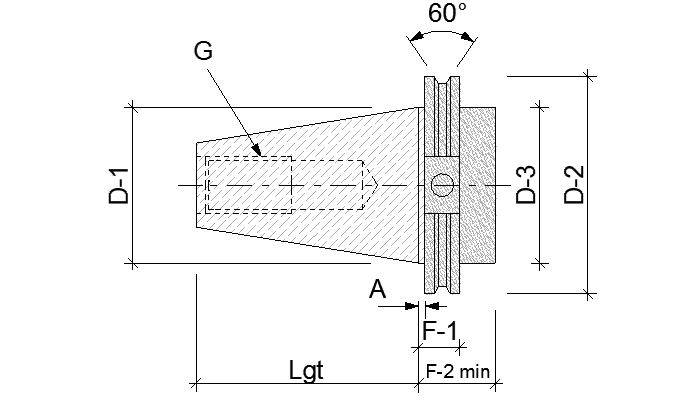
These are the standard dimensional references for CAT V-flange holders. The first grid follows ASME B5.50 (shown here from the Kennametal catalog 7060) and covers sizes 40, 50, and 60. The second follows the ISO 7388-1, DIN 69871, and NFE 62540 metric standards for sizes 40 and 50.
| Size | D-1 | D-2 | D-3 | Lgt | F-1 | F-2 min | A | G |
|---|---|---|---|---|---|---|---|---|
| 40 | 1.750 (44.45) | 2.500 (63.05) | 1.750 (44.45) | 2.687 (68.25) | 0.750 (19.05) | 1.375 (35.00) | 0.125 (3.18) | 5/8-11 thread |
| 50 | 2.750 (69.85) | 3.875 (98.41) | 2.750 (69.85) | 4.000 (101.60) | 0.750 (19.05) | 1.375 (35.00) | 0.125 (3.18) | 1-8 thread |
| 60 | 4.250 (107.95) | 5.500 (139.70) | 4.250 (107.95) | 6.375 (161.93) | 0.750 (19.05) | 1.500 (38.10) | 0.125 (3.18) | 1 1/4-7 thread |
| Size | D1 | D2 | D3 max | L | F1 | F2 min | A | G |
|---|---|---|---|---|---|---|---|---|
| 40 | 44.45 | 63.55 | 50 | 68.4 | 15.9 | 35 | 3.2 | M16 |
| 50 | 69.85 | 97.5 | 80 | 101.75 | 15.9 | 35 | 3.2 | M24 |
Holders built to these two families are often interchangeable in everyday use, but there are small differences in pull stud and flange detail, so confirm the standard before you mix them.
Which CAT Size Do You Need?
For most general-purpose work on a vertical machining center, CAT40 is the default and the easiest size to source. Move up to CAT50 when you need more rigidity for heavy cuts, larger diameters, or sustained production, and the machine spindle supports it. CAT30 trades capacity for lower mass and faster changes on lighter and high-speed machines, and CAT60 is reserved for large mills running big tooling. The spindle on your machine dictates the taper, so match the holder to the spindle first and the application second.
Sell Your Used CAT Tool Holders
Shops that retire a CAT machine, switch tapers, or consolidate operations usually end up with crates of CAT40 and CAT50 holders that no longer have a spindle to run in. Rather than list them one at a time, you can sell the whole lot to us. We buy used and surplus CAT holders, mixed brands and mixed conditions, and we also take surplus carbide tooling and carbide tool holders in the same transaction. Send photos and a rough count, get one quote for the lot, and get paid.
Get a quote on your CAT tool holders
Send a few photos of the shelves and a rough idea of what is there. We buy CAT40, CAT50, and CAT60 holders by the lot, turn quotes around fast, and arrange the freight.
Call 517-514-5196 or fill out the form below for a quote.
Bottom Line
CAT tool holders come in a range of tapers and serve a vast number of purposes across the machine tooling industry. If you are not certain which CAT holder you should buy for your CNC machine, get in touch and our representatives will help you make the right selection for your tooling needs. Clearing out a carousel usually turns up worn carbide as well, and we pay for scrap carbide drills and endmills by the pallet.
Shop Superior Machine & Tool’s selection of CAT Tool Holders
CAT Tool Holders FAQ
What does CAT stand for on a tool holder?
What is the CAT taper angle?
CAT40 vs CAT50, which do I need?
Is a CAT tool holder the same as BT?
What are CAT40 and CAT50 dimensions?
Can I sell used CAT40 and CAT50 tool holders?
Looking for the full CAT lineup? See our CAT tool holders page.
New to CNC tool holders? Our Tool Holders 101 guide covers every taper and type in plain English.