
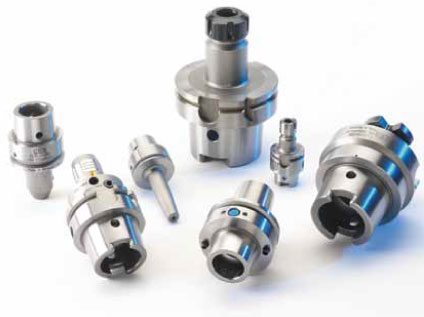
 HSK tool holders are the hollow taper shank interface built for high-speed machining. The name comes from the German Hohlschaftkegel, which means hollow taper shank, and that hollow short taper is what sets HSK apart from the older steep-taper interfaces like CAT and BT. Where a conventional holder seats on the taper alone, an HSK holder contacts the spindle on both the taper and the flange face at the same time. That dual taper and face contact gives HSK its rigidity, its repeatability, and its place on modern CNC spindles. This page covers HSK tool holder types, the common HSK sizes, how the interface works, the dimensions, and how to sell used or surplus HSK tooling when you have it.
Sell your used HSK tool holders
HSK is premium high-speed and aerospace tooling, so a lot of surplus HSK holders is a high-value lot. Send a few photos and a rough count, and we will quote the whole lot fast.
Call 800-822-9524 or fill out the quote form below.
About HSK Tool Holders
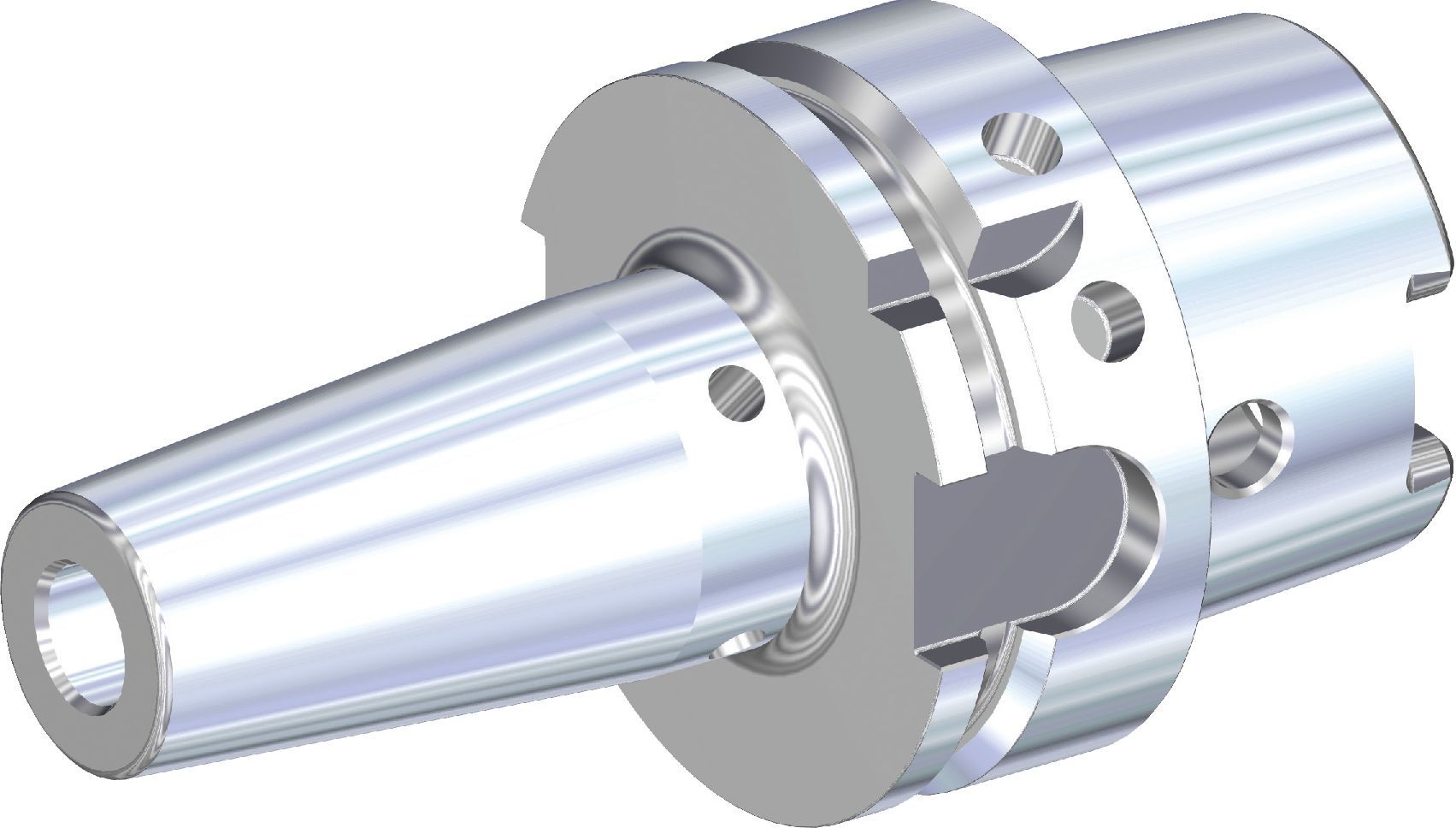
Despite its growing use and acceptance in the United States, HSK technology remains widely misunderstood. Questions about its proper use have created substantial resistance among those who are accustomed to traditional, steep-taper shanks, including CAT, SK, and BT. Although a significant portion of the machine tools imported to the United States from Europe incorporates HSK spindles, steep-taper shanks still represent the most widely used tooling interface. The acronym HSK is the German abbreviation for hollow taper shank.
One of the top-used tool holder standards is HSK, and it is a relatively new design. These holders do not use a retention knob or pull stud, and their defining feature is the hollow shank. The interface was created with high-speed machining (HSM) in mind. Because of that, HSK tool holders have to be balanced with high precision, and it is strongly recommended to use proper balancing equipment for operations that run at exceptionally high rotation speeds.
HSK tool holders require a much higher level of manufacturing than other tool holder types because the tolerance between the spindle receiver and the taper is less than two microns (0.002 mm). They are delicate devices and should be stored where no misbalancing damage can occur.
HSK tool holders support ATC (automatic tool change) and are a reliable choice for high-speed machinery, both in rotation speed and speed of manufacturing. They are lighter and balanced to the highest precision, which makes them a top choice of professional CNC machine operators worldwide. If you run HSK spindles and have older holders coming off the floor, you can sell your used tool holders to us by the lot instead of letting them sit in a drawer.
HSK Tool Holder Types (Forms A to F)
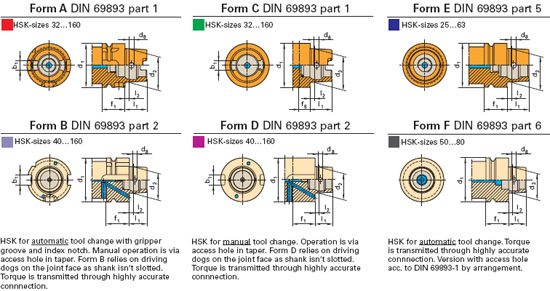
HSK shanks address three different application categories, split across six forms labeled A through F:
- Types A and C serve applications requiring moderate torque and moderate-to-high spindle speeds. Type A is for automatic tool changing, and Type C is for manual changing.
- Types B and D are designed for high torque applications with moderate-to-high spindle speeds. Type B is for automatic changing, and Type D is for manual changing.
- Types E and F are designed for low torque and very high spindle speeds on machines that incorporate ATCs.
The table below summarizes how the six HSK forms compare. It is a quick application guide, not a dimensional reference. For exact dimensions, see the ISO 12164 grid further down the page.
| Form | Tool change | Torque | Spindle speed |
|---|---|---|---|
| HSK-A | Automatic | Moderate | Moderate to high |
| HSK-B | Automatic | High | Moderate to high |
| HSK-C | Manual | Moderate | Moderate to high |
| HSK-D | Manual | High | Moderate to high |
| HSK-E | Automatic | Low | Very high |
| HSK-F | Automatic | Low | Very high |
HSK Sizes
HSK holders are made in a range of sizes, and the size number refers to the nominal diameter of the taper flange in millimeters. The common HSK sizes are HSK-25, HSK-32, HSK-40, HSK-50, HSK-63, HSK-80, HSK-100, and HSK-125. Smaller sizes such as 25 and 32 show up on high-speed spindles and compact machines, while the larger sizes carry the torque for heavier cuts.
In general metalworking, HSK-63 and HSK-100 are the most common sizes by a wide margin. HSK-63 is the workhorse for milling centers, and HSK-100 covers the heavier-duty and higher-torque applications. HSK-50 and HSK-40 are also widely seen, with HSK-40 leaning toward high-speed and lighter work. Because the size sets the taper and flange geometry, holders, collet chucks, and spindle receivers all have to match the same HSK size to fit. If you are clearing a mixed set of sizes, you do not need to sort them. We buy mixed HSK sizes in the same lot, and you can also sell surplus carbide tooling alongside the holders in one transaction.
Comparing HSK With Steep Taper
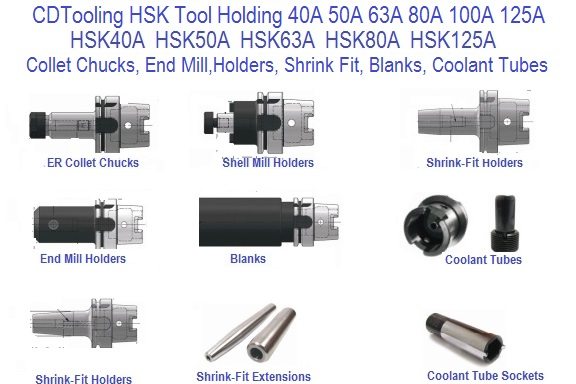 Although HSK has become the primary choice for newly developed machine tools in Europe, substantial skepticism remains in the United States. To clear some of that doubt, it helps to explain a few fundamental differences between HSK and conventional tooling interfaces. If you are weighing the two interfaces directly, read up on the difference between BT and HSK tool holders.
The first category of comparison is radial and axial stiffness, the most important aspects of any machining operation. Unlike conventional shanks, an HSK shank is hollow and the clamping mechanism operates from the inside.
HSK holders incorporate two drive slots that engage drive keys in the spindle receiver. When clamped into the receiver, the wall of the hollow shank deflects slightly. Radial access holes in the shank wall let the clamping mechanism contact an actuation screw. The inner surface of the shank wall also incorporates a chamfer to facilitate clamping.
Although different clamping methods are available depending on the tooling manufacturer, all HSK receivers incorporate segmented collets that expand radially under drawbar pressure to bear against the inner wall of the shank.
Because the collet chamfer matches the chamfer of the shank inner wall, the shank locks securely into the receiver when the drawbar is actuated. When this occurs, elastic deformation of the shank walls creates firm metal-to-metal contact around the shank, and it mates the shank flange with the receiver at the same time.
Assuming equivalent force is applied to the drawbar, twice as much clamping force is exerted on the flange of an HSK shank compared to a steep-taper shank. This extra clamping force makes the radial stiffness of HSK tool holders up to five times greater than the value for CAT, SK, or BT.
HSK Shank (Hollow Taper Shank System)
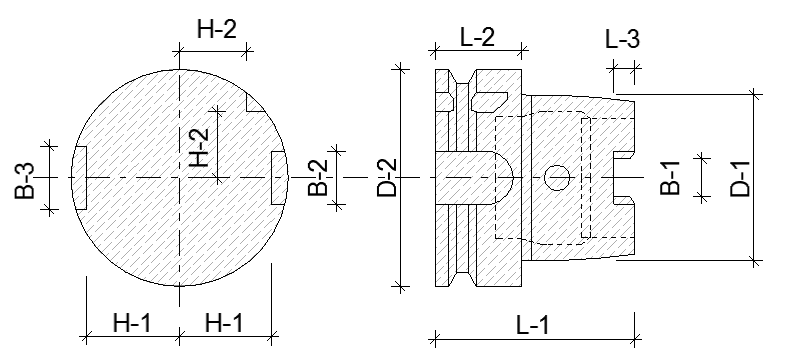
The HSK shank standard is defined by ISO 12164-1 and the DIN 69893 family (DIN 69893-1 covers form A). HSK is not a Morse taper. Morse is a shallow, self-holding taper used for drills and drill chucks. HSK is a hollow short taper that contacts on both the taper and the flange face at the same time.
The taper on all HSK shanks is 1:10.
The flange groove on forms A, B, E, and F is 60 degrees.
HSK-A per DIN 69893-1.
| Size | Form | D-1 | D-2 | L-1 | L-2 | L-3 | B-1 | B-2 | B-3 | H-1 | H-2 |
|---|---|---|---|---|---|---|---|---|---|---|---|
| 63 | A | 48 | 63 | 58 | 26 | 10 | 12.5 | 16 | 18 | 26.5 | 20 |
How HSK Protects the Spindle
The HSK interface offers key advantages for high-speed spindles, tool collisions, and maintenance. When a conventional interface (CAT, SK, BT) runs above 8,000 rpm, the spindle receiver expands at a much higher rate than the tool holder shank, which loosens the connection. With its hollow design, the HSK shank holds contact and acts as a fuse during collisions. When a cutting tool crashes, the holder breaks off and protects the spindle, which reduces repair costs and machine downtime.
Shop Superior Machine and Tool’s selection of HSK Tool Holders
Got surplus HSK tooling? Sell it by the lot
We buy used and surplus HSK tool holders, collet chucks, and high-speed tooling in any HSK size. Send photos and a rough count, get a quote, and get paid. Mixed and unsorted is fine.
Call 800-822-9524 or fill out the form below for a quote.